Building Design Ops infrastructure at ViewSonic
Design Ops | ViewSonic
Overview
When ViewSonic consolidated its entire product ecosystem under a unified account portal—routing users from ViewSonic Account into a single all-product dashboard before reaching web product system and other surfaces—the web design team inherited not just a complex UX challenge, but a structural operations problem.
Concurrent workstreams, invisible capacity, and ad-hoc request flooding created conditions where quality and team sustainability were both at risk.As a starter of a Design Ops intervention, I helped transform how the design organization planned, communicated, and delivered work. The outcome: 90%+ on-time delivery and an internal satisfaction score of 80/100, both validated through formal organizational surveys and tooling data.
Background | When a Product Problem Revealed an Ops Problem
- 🎨 My Role: Product Designer of web products
- ⏱️ Duration: 2 months~
The Account Unification project had a clear product goal—create a seamless, centralized entry point across ViewSonic's full product portfolio. But as the project scaled, a different problem surfaced beneath it. Design was operating without infrastructure. Requests arrived through informal channels with no standardized intake.
Workload had no visible ceiling. When five products move simultaneously and none of the coordination is formalized, designers stop doing design—they spend their time managing ambiguity instead.
Three failure modes became visible:
- Capacity was invisible. Without centralized tracking, there was no shared language for "we're at capacity." Stakeholders couldn't see it, and designers couldn't prove it.
- Unmanaged Design Debt. High-pressure integration forced us to bypass standards. By sacrificing refactoring for immediate shipping, we were effectively borrowing from future product quality.
- Direct Risk Absorption. The team acted as the organization's "shock absorber." Without an operational buffer, deadline stress converted directly into designer burnout.
Design Strategy | Treating Process as a Design Problem
Together with a co-initiator, I approached the ops challenge the same way I'd approach a product challenge: identify the highest-leverage constraint, prototype cheaply, and iterate based on real feedback.
Phase 1
We launched a two-week sprint cycle using a physical Kanban board—zero-cost, high-clarity. The goal was to transform our workflow into a shared artifact that anyone could read.
- Data-Driven Negotiation: Within two cycles, we achieved a four-week lookahead, allowing us to negotiate deadlines with evidence instead of intuition.
- Immediate Insight: Within two Sprints, we gained clear visibility into 2–4 weeks of upcoming work, allowing us to negotiate deadlines with data rather than intuition.
Phase 2
After validating the manual pilot, we migrated the workflow to our enterprise platform and institutionalized the system across the entire design organization.
- Redundant Work Reduction: Established file-naming conventions and shared component libraries, reclaiming time from low-value production for high-impact product work.
- Operational Protection: Implemented a single, formal intake channel. The system acted as a "buffer," absorbing ad-hoc friction so designers could focus on deep work without constant interruption.
Impact|Measured by Data and Culture

- On-time delivery rate : > 90%
- Team satisfaction with Design Ops workflow : > 80/100
Beyond the numbers, the account unification project shipped with design coherence across the full product surface—a unified login experience connecting ViewSonic Account to the all-product dashboard and downstream to myviewboard.com—something that would not have been achievable under the previous operating conditions.
Highlights|Account migration
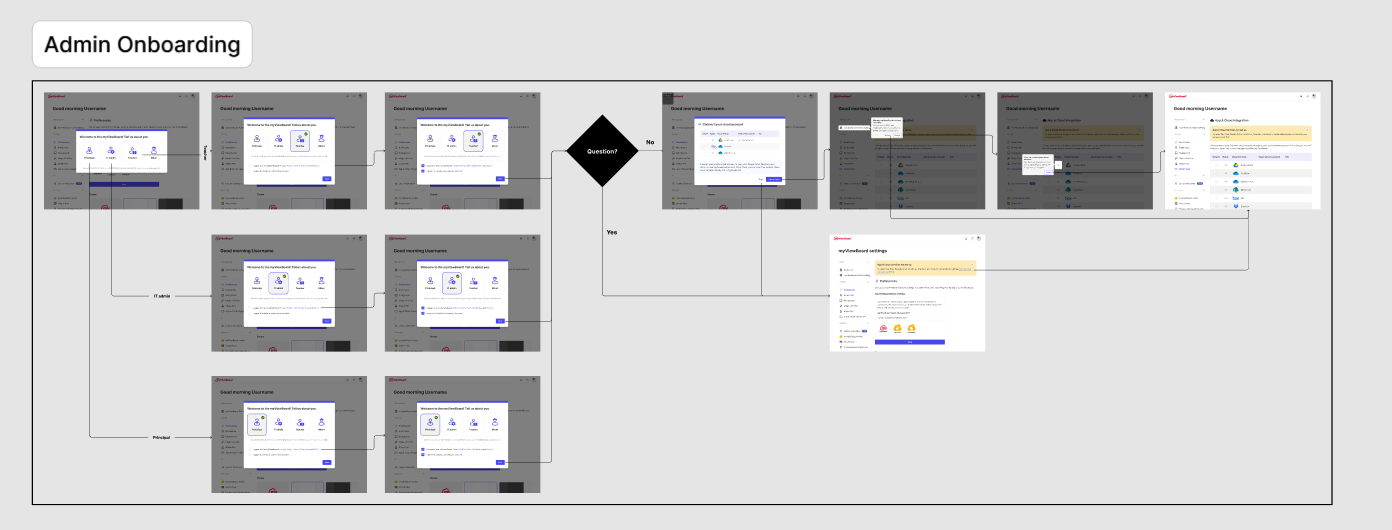
The Account Migration was a logic-heavy integration requiring multiple specialized deliverables.
The established Design Ops framework ensured that these high-density tasks were delivered predictably and at scale.
- Integrated User Flows: Mapped complex migration paths from legacy systems to the unified dashboard, ensuring zero drop-off during the transition
- Prototypes: Validated logic across multiple product surfaces (ViewSonic Account, myviewboard.com) to align stakeholders before engineering execution.
- Dynamic Requirement Handling: The sprint system allowed us to absorb and prioritize shifting requirements in real-time without disrupting the core delivery timeline.
- Implementation Documentation: Authored comprehensive design specs and user-guidance docs to bridge the gap between design, engineering, and end-users.
UI
Reflection | Leading Beyond the Canvas
The lesson I carry from this project isn't about Kanban or sprint cadences. It's about where a senior designer's leverage actually lives.
- Process design is product design. The most impactful design decision I made during the account unification wasn't a UI choice—it was choosing to formalize how design work moved through the organization. That decision had downstream effects on every designer, every stakeholder, and every product surface.
- Shared systems require co-ownership to survive. Working with a co-initiator wasn't a constraint—it was what made adoption possible. A system that one person builds and one person owns is fragile. A system two people believe in can propagate.